

Showing posts with label Great Depression. Show all posts
Showing posts with label Great Depression. Show all posts
June 14, 2011
The Truth About the Economy
Robert Reich, the Secretary of Labor under President Clinton, breaks down how the economy went from great to horrific in six simple steps.


May 26, 2011
Nobel Laurieate Krugman: The Debt Is Not a Crisis, Risk of Depression IS
Last year Paul Krugman warned that we seemed to be heading into the “Third Depression” — by which, he explains, he meant we were in a prolonged period of economic weakness. The signs are all around us that the "recovery" is a jobless one. The rate of growth in jobs will take years to hire back all who have been laid off. In fact, federal and state workers and teachers are now facing lay off in the next fiscal year.
Do we really want to face a "lost decade"? Or are we willing to stimulate the economy before this gets any worse?
Debt Arithmetic
The whole tone of current discussion about deficits is one of urgency: deficits must be brought down now now now or crisis looms. Where is this coming from? Not from the arithmetic.
The way the story is often told, deficits mean higher debt, which means higher interest payments, which can mean a spiral into bankruptcy. And qualitatively that’s not wrong. If you put numbers to it, however, for countries that are not facing huge risk premia, the spiral is very, very slow.
Here’s a sample calculation.
The latest IMF Fiscal Monitor predicts that general government in the US — that’s federal, state and local combined — will run a deficit of 7.5 percent of GDP next year, and that net debt will be 75 percent of GDP.
So how fast would the debt spiral be going?
You need to bear in mind that growth and inflation limit the rate of rise in the debt ratio. Suppose that we have 4 percent nominal GDP growth, which is actually low by historical standards. This shaves 3 percentage points off the rise in the debt/GDP ratio. So a year later, given those numbers, debt rises by 4.5 percentage points of GDP.
What’s the interest burden of that rise? At minimum we should correct for inflation, so use the TIPS yield. That’s currently below 1, but let’s be pessimistic and call it 2. Even so, the added interest burden is less than one-tenth of one percent of GDP.
So even with substantial deficits, the pace of long-term budget worsening is very slow. If it’s a debt death spiral, it’s a slooooowww motion death spiral.
But, say the critics, psychology can change suddenly, sharply raising those interest costs. The question then is why psychology should change. Investors can do the same arithmetic I’ve just done; why should they panic over a small rise in the interest burden?
Now, investors might well panic over signs of political deadlock — but that could happen regardless of the current year’s deficit.
Still, Serious People tell us that investors will turn on us unless we slash the deficit immediately — and they know this because, well, um …
As I’ve often written, we’re in a strange state now where people who actually take textbook economics and simple arithmetic seriously are seen as dangerously radical and irresponsible, while people who believe in invisible bond vigilantes and confidence fairies, who claim to know what the market will want even though there’s no sign of that desire in current asset prices, are viewed as Very Serious.
Anyway, the arithmetic of debt is much less scary than you might think.

September 08, 2010
Hellegers: American Income Inequality is the Cause of our Crisis
The Tea Party movement is just a clever disguise for an oilman to control America. Inequality has always be a moral issue, now it is clearly an economic issue. The rich have seized control of policy making in the US and they may again seize control of government in the next election. As usual, Juan Cole has it right.
Informed Comment

Informed Comment
Plutarch, writing almost 2,000 years ago, told us that “an imbalance between rich and poor is the oldest and most fatal ailment of all republics.”
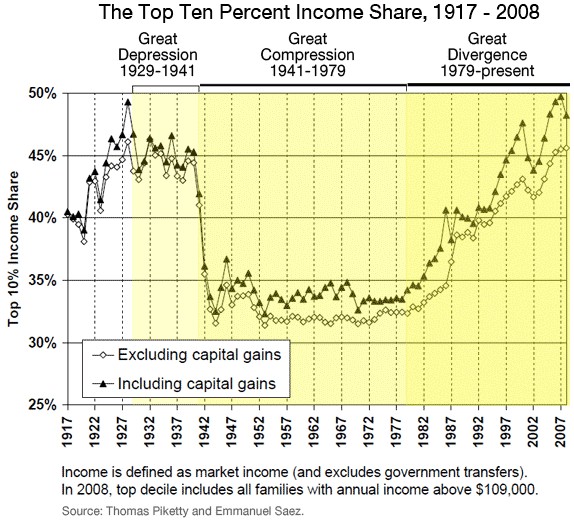
Below is a chart that shows the course of income imbalance over the last 93 years in the U.S. If it showed the course of net worth imbalance, it would be much more dramatic. If it showed data for the top tenth of one percent– not just the top ten percent– it would be extraordinarily dramatic.
Inter alia, the chart shows that both the Great Depression of the ’30s and the present crisis were immediately preceded by great buildups in inequality. When ordinary people lack the wealth to buy things– houses for example–the system crashes.
There’s also a lot of data that show that economic equality conduces, quite literally, to the health of society. The correlation between equality and most measures of well-being is stronger than the correlation between wealth and well-being. See Richard G. Wilkinson & Kate Pickett, The Spirit Level (2009). For a good review of that book, see David Runciman in the London Review of Books, Oct. 22, 2009, .
Still, the rich consistently try to destroy egalitarianism, because for their segment, inequality is fine. It means increasingly desperate people trying increasingly hard to serve the rich. The rich also try to destroy the political means by which the rest of society might seek relief, which is exactly Plutarch’s point. Witness the rise of the present-day Tea Parties. A recent article in the New Yorker describes how the Koch brothers– Texas billionaires– have lavishly financed that movement.
In 1980 Ronald Reagan managed to break the egalitarian consensus that had held since FDR. (See the chart.) The key was playing on racial divisions. Reagan’s first campaign speech was in Philadelphia, Misssissippi. That town is famous for one thing only. It’s where three civil rights workers were lynched and murdered in the 1960s. Reagan’s target audience didn’t miss his message. Social justice was cast in terms of giveaways to demonized blacks– mythologized welfare queens in Cadillacs. Reagan’s ascendancy, by his exploitation of the race issue, is described by Thomas B. & Mary D. Edsall in Chain Reaction (1992). Thomas Edsall, until his retirement, was a reporter for the Washington Post.
The U.S. is now more unequal than a number of countries in Latin America. When I was younger it was accepted wisdom that those countries would never get anywhere until they solved the inequality problem.
August 31, 2010
Our Leadership Have Been Idiots about the Economy
The long standing macro-economic model that has been the mainstay of training in the 20th century, the Keynesian model, predicts current events in our economy. Yet everyone tries to hold onto the long repudiated "supply-side" model that took hold of politics in the 80s. The result is that we are headed for deflation, and if the Republicans get there way a new Great Depression, with a "D".
Brother, Can You Paradigm? - NYTimes.com: "Brother, Can You Paradigm?A few months back one of my original mentors in economics — someone who got his graduate training in the pre-fresh-water era — asked me whether there was anything about the current crisis that required fundamentally new analysis. We agreed that there wasn’t."
Image via WikipediaThis is one of the untold tales of the mess we’re in. Contrary to what you may have heard, there’s very little that’s baffling about our problems — at least not if you knew basic, old-fashioned macroeconomics. In fact, someone who learned economics from the original 1948 edition of Samuelson’s textbook would feel pretty much at home in today’s world. If economists seem totally at sea, it’s because they have carefully unlearned the old wisdom. If policy has failed, it’s because policy makers chose not to believe their own models.


November 18, 2009
More Change We Can't Believe In
Obama really is flobbing the economy. And we all will pay for it, except of course for the Bankers.
The AIG report - Paul Krugman Blog - NYTimes.com:
![Reblog this post [with Zemanta]](https://lh3.googleusercontent.com/blogger_img_proxy/AEn0k_uETjf-es-cJDB8kbQv2l6YmOndMkIfz5l5GnIfQ3iy4gX3pLobJx2n_a8dVgiFqGy6JSuWoIVaodHK75gyrWkuKhOdX_gGjIQO27jUqEkQ66DZpCjerK9hNMPRpcM3KH8eubKM4Nou3GewmIJ6AQ22=s0-d)

The AIG report - Paul Krugman Blog - NYTimes.com:
"Brad DeLong says that the loss of public trust due to the kid-gloves treatment of bankers has raised the probability of another Great Depression, because the public won’t support another round of bailouts even if it becomes desperately necessary. I agree — but I think the bigger cost is that we’ve greatly increased the chance of a Japanese-style lost decade, with I would now give roughly even odds of happening. Why? Because bank-friendly policies have squandered public trust in all government action: try talking to the general public about stimulus, and it’s all confounded in their minds with the deeply unpopular bailouts."
September 21, 2009
Why Haven't Any Wall Street Tycoons Been Sent to the Slammer?
All I will say is find them and then hang them high.
via t r u t h o u t | Why Haven't Any Wall Street Tycoons Been Sent to the Slammer?.


More than a year into the gravest financial crisis since the Great Depression, millions of Americans have seen their home values and retirement savings plunge and their jobs evaporate.
What they haven't seen are any Wall Street tycoons forced to swap their multi-million dollar jobs and custom-made suits for dishwashing and prison stripes.
There are plenty of civil and class-action lawsuits from aggrieved investors angered by the losses in their mortgage bonds, hedge funds or pensions. Regulators have stepped up their vigilance after the fact. But to date, no captain of finance tied to the crisis has walked the plank.
There have been some high-profile arrests and federal convictions of financial giants — such as Ponzi scheme king Bernard Madoff and Stanford Financial Group chairman Robert Allen Stanford. They weren't among the causes of the financial meltdown, however, just poster boys for an era of lax enforcement, weak regulation and devout faith in free markets.
"A lot of people who are responsible (for the crisis) seem to have gotten awfully rich in the process," said Barbara Roper, the director of investor protection for the Consumer Federation of America.
The absence of what many would call justice stands out all the more because past financial crises always had their villains. The depression-era had electricity and railroad magnate Samuel Insull, who partly inspired the movie "Citizen Kane." The savings and loan crisis of the 1980's had banker Charles Keating. Energy giant Enron Corp.'s spectacular collapse offered the late CEO Kenneth Lay, a Texas crony of President George W. Bush.
Yet there's no such poster child for the Great Recession, as today's crisis is now called.
One may yet emerge. The FBI has more than 580 large-scale corporate fraud investigations under way. At least 40 of them are scrutinizing players in sub-prime mortgage lending, which was the first domino to fall and triggered a global financial crisis.
"The investigations are very complex; it's not something that's going to turn overnight," said Bill Carter, a spokesman at FBI headquarters. "They are labor intensive. They involve a review of records."
via t r u t h o u t | Why Haven't Any Wall Street Tycoons Been Sent to the Slammer?.
Related articles by Zemanta
- The SEC gets neutered again (money.cnn.com)
- Judge revokes bond for financier Stanford (msnbc.msn.com)
- SEC takes a few more 'baby steps' towards regulation (americablog.com)
- Madoff Lawyer: Bernie Should Only Get 12-Year Sentence (huffingtonpost.com)
- Sheldon Filger: Bernard Madoff and the Art of Financial Self-Delusion (huffingtonpost.com)
- A year after financial crisis, the consumer economy is dead (citizengkar.wordpress.com)
- Chomsky: What America's 'Crisis' Means to the Rest of the World (citizengkar.wordpress.com)
Subscribe to:
Posts (Atom)


