Citizen G'kar: Musings on Earth

Showing posts with label Medicare. Show all posts

October 12, 2011

The Seven Biggest Economic Lies


The Seven Biggest Economic Lies

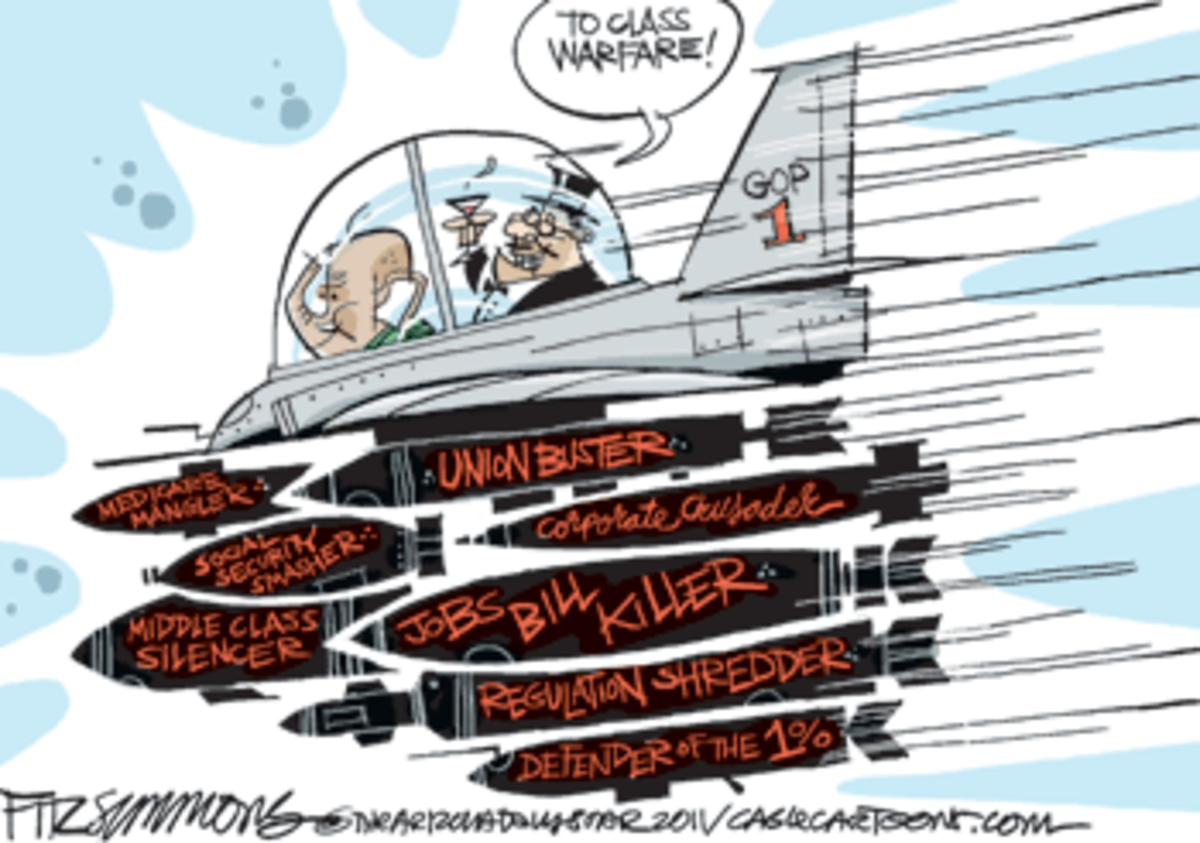
class warfareThe President’s Jobs Bill doesn’t have a chance in Congress — and the Occupiers on Wall Street and elsewhere can’t become a national movement for a more equitable society – unless more Americans know the truth about the economy.
Here’s a short (2 minute 30 second) effort to rebut the seven biggest whoppers now being told by those who want to take America backwards.
The major points:
  • Tax cuts for the rich trickle down to everyone else. Baloney. Ronald Reagan and George W. Bush both sliced taxes on the rich and what happened? Most Americans’ wages (measured by the real median wage) began flattening under Reagan and have dropped since George W. Bush. Trickle-down economics is a cruel joke.
  • Higher taxes on the rich would hurt the economy and slow job growth. False. From the end of World War II until 1981, the richest Americans faced a top marginal tax rate of 70 percent or above. Under Dwight Eisenhower it was 91 percent. Even after all deductions and credits, the top taxes on the very rich were far higher than they’ve been since. Yet the economy grew faster during those years than it has since. (Don’t believe small businesses would be hurt by a higher marginal tax; fewer than 2 percent of small business owners are in the highest tax bracket.)
  • Shrinking government generates more jobs. Wrong again. It means fewer government workers – everyone from teachers, fire fighters, police officers, and social workers at the state and local levels to safety inspectors and military personnel at the federal. And fewer government contractors, who would employ fewer private-sector workers. According to Moody’s economist Mark Zandi (a campaign advisor to John McCain), the $61 billion in spending cuts proposed by the House GOP will cost the economy 700,000 jobs this year and next.

  • Cutting the budget deficit now is more important than boosting the economy. Untrue. With so many Americans out of work, budget cuts now will shrink the economy. They’ll increase unemployment and reduce tax revenues. That will worsen the ratio of the debt to the total economy. The first priority must be getting jobs and growth back by boosting the economy. Only then, when jobs and growth are returning vigorously, should we turn to cutting the deficit.
    robert reich
  • Medicare and Medicaid are the major drivers of budget deficits. Wrong. Medicare and Medicaid spending is rising quickly, to be sure. But that’s because the nation’s health-care costs are rising so fast. One of the best ways of slowing these costs is to use Medicare and Medicaid’s bargaining power over drug companies and hospitals to reduce costs, and to move from a fee-for-service system to a fee-for-healthy outcomes system. And since Medicare has far lower administrative costs than private health insurers, we should make Medicare available to everyone.
  • Social Security is a Ponzi scheme. Don’t believe it. Social Security is solvent for the next 26 years. It could be solvent for the next century if we raised the ceiling on income subject to the Social Security payroll tax. That ceiling is now $106,800.
  • It’s unfair that lower-income Americans don’t pay income tax. Wrong. There’s nothing unfair about it. Lower-income Americans pay out a larger share of their paychecks in payroll taxes, sales taxes, user fees, and tolls than everyone else.
robert reichDemagogues through history have known that big lies, repeated often enough,  start being believed — unless they’re rebutted. These seven economic whoppers are just plain wrong. Make sure you know the truth – and spread it on.

Enhanced by Zemanta

February 12, 2010

Republican Medicare Cuts

Even without Dubya, the Republicans are still into Doublethink. It is, even when it isn't, no means yes, and "No to Medicare Cuts!" means bigger Medicare cuts.

Republican Medicare Cuts - Paul Krugman Blog - NYTimes.com:

"So, Newt Gingrich and John Goodman say,

Clipped version of Gingrich and Lott.jpg, a fi...Image via Wikipedia

Don’t cut Medicare. The reform bills passed by the House and Senate cut Medicare by approximately $500 billion. This is wrong.


Leave aside the mind-killing irony of Newt Gingrich — New Gingrich! — denouncing Medicare cuts. What are Republicans themselves proposing?

Well, Rep. Paul Ryan’s Roadmap for America’s Future calls for the eventual elimination of Medicare as we know it, replacing it with a system of vouchers that would, eventually, account for a steadily declining share of GDP. But what about the next decade? Mr. Ryan’s release says that it

Strengthens the current program with changes such as income-relating drug benefit premiums to ensure long-term sustainability.


What does that mean? The CBO, helpfully, translates (pdf):

People who are age 65 or older in 2020 and other existing enrollees at that time would continue to be covered by the current program, although some higher income enrollees would pay higher premiums, and some program payments would be reduced.


In other words, Medicare would face cuts. And the CBO’s detailed analysis provides an estimate of those cuts. I’ve taken the table comparing projected spending with baseline as a share of GDP (xls), and scaled it up using the CBO’s projections of GDP. What I get is an estimated cut in Medicare spending over the next decade of about … $650 billion.

So, cutting Medicare by $500 billion is wrong — support Republicans, who want to cut it by $650 billion!"

Reblog this post [with Zemanta]

October 30, 2009

The 2010 Reforms in the House Healthcare Reform Bill

Here is a first look at the House Health Insurance reform bill that would initiate these changes in 2010! It is truly worthy of our support.
MIAMI - SEPTEMBER 22:  Elio Medina and others ...
Image by Getty Images via Daylife

House leadership has released this fact sheet on the key elements of the House healthcare reform bill that will begin in 2010.

House leadership has released this fact sheet on the key elements of the House healthcare reform bill that will begin in 2010 [pdf].


Among the most important of these front-loaded provision are the creation of the high risk pool, extension of COBRA benefits (which should also include some sort of subsidy program, since COBRA rates are often unaffordable, though select groups do receive assistance under the Recovery Act), upping the age that people can be covered by their parents' plans, and the increased funding for Community Health Centers are all very good starts for 2010. The most key for staunching the bleeding in our system, if you will, are the high risk pool and the Community Health Center funding. More of the uninsured will be able to get insurance through the pool and the CHCs, which are absolutely critical to providing care for the uninsured, will at least see some increased ability to do so.

A handful of the reforms will immediately address issues for Medicare beneficiaries, all solid reforms that should also provide some political help in 2010--seniors vote.

Here's the full list of what will start happening in 2010 under the bill.


  1. BEGINS TO CLOSE THE MEDICARE PART D DONUT HOLE — Reduces the donut hole by $500 and institutes a 50% discount on brand-name drugs, effective January 1, 2010.


  1. IMMEDIATE HELP FOR THE UNINSURED UNTIL EXCHANGE IS AVAILABLE (INTERIM HIGH-RISK POOL) — Creates a temporary insurance program until the Exchange is available for individuals who have been uninsured for several months or have been denied a policy because of pre-existing conditions.


  1. BANS LIFETIME LIMITS ON COVERAGE—Prohibits health insurance companies from placing lifetime caps on coverage.


  1. ENDS RESCISSIONS—Prohibits insurers from nullifying or rescinding a patient’s policy when they file a claim for benefits, except in the case of fraud.


  1. EXTENDS COVERAGE FOR YOUNG PEOPLE UP TO 27TH BIRTHDAY THROUGH PARENTS’ INSURANCE— Requires health plans to allow young people through age 26 to remain on their parents’ insurance policy, at the parents’ choice.


  1. ELIMINATES COST-SHARING FOR PREVENTIVE SERVICES IN MEDICARE—Eliminates co-payments for preventive services and exempts preventive services from deductibles under the Medicare program.


  1. IMPROVES HELP FOR LOW-INCOME MEDICARE BENEFICIARIES—Improves the low-income protection programs in Medicare to assure more individuals are able to access this vital help.


  1. PROVIDES NEW CONSUMER PROTECTIONS IN MEDICARE ADVANTAGE— Prohibits Medicare Advantage plans from charging enrollees higher cost-sharing for services in their private plan than what is charged in traditional Medicare.


  1. IMMEDIATE SUNSHINE ON PRICE GOUGING—Discourages excessive price increases by insurance companies through review and disclosure of insurance rate increases.


  1. CONTINUITY FOR DISPLACED WORKERS—Allows Americans to keep their COBRA coverage until the Exchange is in place and they can access affordable coverage.


  1. CREATES NEW, VOLUNTARY, PUBLIC LONG-TERM CARE INSURANCE PROGRAM—Creates a long-term care insurance program to be financed by voluntary payroll deductions to provide benefits to adults who become functionally disabled.


  1. HELP FOR EARLY RETIREES—Creates a $10 billon fund to finance a temporary reinsurance program to help offset the costs of expensive health claims for employers that provide health benefits for retirees age 55-64.


  1. COMMUNITY HEALTH CENTERS—Increases funding for Community Health Centers to allow for a doubling of the number of patients seen by the centers over the next 5 years.


  1. INCREASING NUMBER OF PRIMARY CARE DOCTORS — Provides new investment in training programs to increase the number of primary care doctors, nurses, and public health professionals.


via The 2010 Reforms in the House Healthcare Reform Bill | PEEK | AlterNet.


Reblog this post [with Zemanta]

August 14, 2009

The Truth about Healthcare


President Lyndon B. Johnson signing the Medica...
Image via Wikipedia


Lots of common sense here. Seems a bit uncommon these days of right wing propaganda filling our media sources. Here is the truth.
David Axelrod
Senior Adviser to the President

We launched www.WhiteHouse.gov/realitycheck this week to knock down the rumors and lies that are floating around the internet. You can find the information below, and much more, there. For example, we've just added a video of Nancy-Ann DeParle from our Health Reform Office tackling a viral email head on. Check it out:

Health Insurance Reform Reality Check

8 ways reform provides security and stability to those with or without coverage

  1. Ends Discrimination for Pre-Existing Conditions: Insurance companies will be prohibited from refusing you coverage because of your medical history.

  2. Ends Exorbitant Out-of-Pocket Expenses, Deductibles or Co-Pays: Insurance companies will have to abide by yearly caps on how much they can charge for out-of-pocket expenses.

  3. Ends Cost-Sharing for Preventive Care: Insurance companies must fully cover, without charge, regular checkups and tests that help you prevent illness, such as mammograms or eye and foot exams for diabetics.

  4. Ends Dropping of Coverage for Seriously Ill: Insurance companies will be prohibited from dropping or watering down insurance coverage for those who become seriously ill.

  5. Ends Gender Discrimination: Insurance companies will be prohibited from charging you more because of your gender.

  6. Ends Annual or Lifetime Caps on Coverage: Insurance companies will be prevented from placing annual or lifetime caps on the coverage you receive.

  7. Extends Coverage for Young Adults: Children would continue to be eligible for family coverage through the age of 26.

  8. Guarantees Insurance Renewal: Insurance companies will be required to renew any policy as long as the policyholder pays their premium in full. Insurance companies won't be allowed to refuse renewal because someone became sick.


Learn more and get details: http://www.WhiteHouse.gov/health-insurance-consumer-protections/

8 common myths about health insurance reform

  1. Reform will stop "rationing" - not increase it: It’s a myth that reform will mean a "government takeover" of health care or lead to "rationing." To the contrary, reform will forbid many forms of rationing that are currently being used by insurance companies.

  2. We can’t afford reform: It's the status quo we can't afford. It’s a myth that reform will bust the budget. To the contrary, the President has identified ways to pay for the vast majority of the up-front costs by cutting waste, fraud, and abuse within existing government health programs; ending big subsidies to insurance companies; and increasing efficiency with such steps as coordinating care and streamlining paperwork. In the long term, reform can help bring down costs that will otherwise lead to a fiscal crisis.

  3. Reform would encourage "euthanasia": It does not. It’s a malicious myth that reform would encourage or even require euthanasia for seniors. For seniors who want to consult with their family and physicians about end-of life decisions, reform will help to cover these voluntary, private consultations for those who want help with these personal and difficult family decisions.

  4. Vets' health care is safe and sound: It’s a myth that health insurance reform will affect veterans' access to the care they get now. To the contrary, the President's budget significantly expands coverage under the VA, extending care to 500,000 more veterans who were previously excluded. The VA Healthcare system will continue to be available for all eligible veterans.

  5. Reform will benefit small business - not burden it: It’s a myth that health insurance reform will hurt small businesses. To the contrary, reform will ease the burdens on small businesses, provide tax credits to help them pay for employee coverage and help level the playing field with big firms who pay much less to cover their employees on average.

  6. Your Medicare is safe, and stronger with reform: It’s myth that Health Insurance Reform would be financed by cutting Medicare benefits. To the contrary, reform will improve the long-term financial health of Medicare, ensure better coordination, eliminate waste and unnecessary subsidies to insurance companies, and help to close the Medicare "doughnut" hole to make prescription drugs more affordable for seniors.

  7. You can keep your own insurance: It’s myth that reform will force you out of your current insurance plan or force you to change doctors. To the contrary, reform will expand your choices, not eliminate them.

  8. No, government will not do anything with your bank account: It is an absurd myth that government will be in charge of your bank accounts.  Health insurance reform will simplify administration, making it easier and more convenient for you to pay bills in a method that you choose.  Just like paying a phone bill or a utility bill, you can pay by traditional check, or by a direct electronic payment. And forms will be standardized so they will be easier to understand. The choice is up to you – and the same rules of privacy will apply as they do for all other electronic payments that people make.


Learn more and get details:
http://www.WhiteHouse.gov/realitycheck
http://www.WhiteHouse.gov/realitycheck/faq

8 Reasons We Need Health Insurance Reform Now

  1. Coverage Denied to Millions: A recent national survey estimated that 12.6 million non-elderly adults – 36 percent of those who tried to purchase health insurance directly from an insurance company in the individual insurance market – were in fact discriminated against because of a pre-existing condition in the previous three years or dropped from coverage when they became seriously ill. Learn more: http://www.healthreform.gov/reports/denied_coverage/index.html

  2. Less Care for More Costs: With each passing year, Americans are paying more for health care coverage. Employer-sponsored health insurance premiums have nearly doubled since 2000, a rate three times faster than wages. In 2008, the average premium for a family plan purchased through an employer was $12,680, nearly the annual earnings of a full-time minimum wage job.  Americans pay more than ever for health insurance, but get less coverage. Learn more: http://www.healthreform.gov/reports/hiddencosts/index.html

  3. Roadblocks to Care for Women: Women’s reproductive health requires more regular contact with health care providers, including yearly pap smears, mammograms, and obstetric care. Women are also more likely to report fair or poor health than men (9.5% versus 9.0%). While rates of chronic conditions such as diabetes and high blood pressure are similar to men, women are twice as likely to suffer from headaches and are more likely to experience joint, back or neck pain. These chronic conditions often require regular and frequent treatment and follow-up care. Learn more: http://www.healthreform.gov/reports/women/index.html

  4. Hard Times in the Heartland: Throughout rural America, there are nearly 50 million people who face challenges in accessing health care. The past several decades have consistently shown higher rates of poverty, mortality, uninsurance, and limited access to a primary health care provider in rural areas. With the recent economic downturn, there is potential for an increase in many of the health disparities and access concerns that are already elevated in rural communities. Learn more: http://www.healthreform.gov/reports/hardtimes

  5. Small Businesses Struggle to Provide Health Coverage: Nearly one-third of the uninsured – 13 million people – are employees of firms with less than 100 workers. From 2000 to 2007, the proportion of non-elderly Americans covered by employer-based health insurance fell from 66% to 61%. Much of this decline stems from small business. The percentage of small businesses offering coverage dropped from 68% to 59%, while large firms held stable at 99%. About a third of such workers in firms with fewer than 50 employees obtain insurance through a spouse. Learn more: http://www.healthreform.gov/reports/helpbottomline

  6. The Tragedies are Personal: Half of all personal bankruptcies are at least partly the result of medical expenses. The typical elderly couple may have to save nearly $300,000 to pay for health costs not covered by Medicare alone. Learn more: http://www.healthreform.gov/reports/inaction

  7. Diminishing Access to Care: From 2000 to 2007, the proportion of non-elderly Americans covered by employer-based health insurance fell from 66% to 61%. An estimated 87 million people - one in every three Americans under the age of 65 - were uninsured at some point in 2007 and 2008. More than 80% of the uninsured are in working families. Learn more: http://www.healthreform.gov/reports/inaction/diminishing/index.html

  8. The Trends are Troubling: Without reform, health care costs will continue to skyrocket unabated, putting unbearable strain on families, businesses, and state and federal government budgets. Perhaps the most visible sign of the need for health care reform is the 46 million Americans currently without health insurance - projections suggest that this number will rise to about 72 million in 2040 in the absence of reform. Learn more: http://www.WhiteHouse.gov/assets/documents/CEA_Health_Care_Report.pdf


Visit WhiteHouse.gov


Reblog this post [with Zemanta]