Citizen G'kar: Musings on Earth

Showing posts with label History. Show all posts

September 08, 2010

Hellegers: American Income Inequality is the Cause of our Crisis

The Tea Party movement is just a clever disguise for an oilman to control America. Inequality has always be a moral issue, now it is clearly an economic issue. The rich have seized control of policy making in the US and they may again seize control of government in the next election. As usual, Juan Cole has it right.

Informed Comment

Plutarch, writing almost 2,000 years ago, told us that “an imbalance between rich and poor is the oldest and most fatal ailment of all republics.”
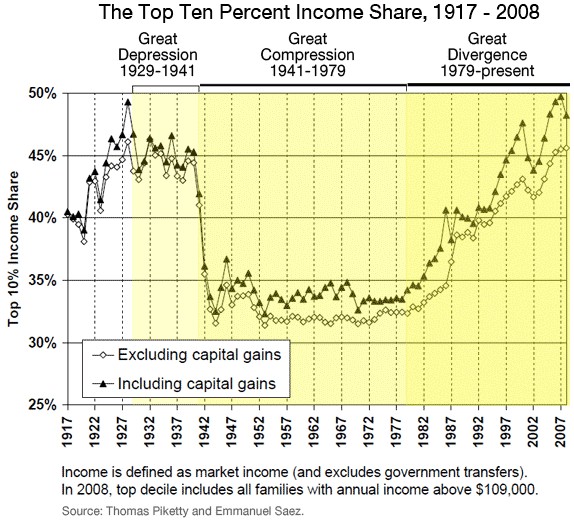
Below is a chart that shows the course of income imbalance over the last 93 years in the U.S. If it showed the course of net worth imbalance, it would be much more dramatic. If it showed data for the top tenth of one percent– not just the top ten percent– it would be extraordinarily dramatic.
Inter alia, the chart shows that both the Great Depression of the ’30s and the present crisis were immediately preceded by great buildups in inequality. When ordinary people lack the wealth to buy things– houses for example–the system crashes.
There’s also a lot of data that show that economic equality conduces, quite literally, to the health of society. The correlation between equality and most measures of well-being is stronger than the correlation between wealth and well-being. See Richard G. Wilkinson & Kate Pickett, The Spirit Level (2009). For a good review of that book, see David Runciman in the London Review of Books, Oct. 22, 2009, .
Still, the rich consistently try to destroy egalitarianism, because for their segment, inequality is fine. It means increasingly desperate people trying increasingly hard to serve the rich. The rich also try to destroy the political means by which the rest of society might seek relief, which is exactly Plutarch’s point. Witness the rise of the present-day Tea Parties. A recent article in the New Yorker describes how the Koch brothers– Texas billionaires– have lavishly financed that movement.
In 1980 Ronald Reagan managed to break the egalitarian consensus that had held since FDR. (See the chart.) The key was playing on racial divisions. Reagan’s first campaign speech was in Philadelphia, Misssissippi. That town is famous for one thing only. It’s where three civil rights workers were lynched and murdered in the 1960s. Reagan’s target audience didn’t miss his message. Social justice was cast in terms of giveaways to demonized blacks– mythologized welfare queens in Cadillacs. Reagan’s ascendancy, by his exploitation of the race issue, is described by Thomas B. & Mary D. Edsall in Chain Reaction (1992). Thomas Edsall, until his retirement, was a reporter for the Washington Post.
The U.S. is now more unequal than a number of countries in Latin America. When I was younger it was accepted wisdom that those countries would never get anywhere until they solved the inequality problem.
Enhanced by Zemanta

January 26, 2010

Informed Comment: Oregon's rich getting richer and all others falling behind, wage study shows | But it's a National Trend and We are Becoming Florence

Informed Comment:
"Oregon's rich getting richer and all others falling behind, wage study shows | Oregon Business News - OregonLive.com

WASHINGTON - JUNE 2:  Former first lady Nancy ...Image by Getty Images via Daylife

' The free-market fervor that has gripped the country since the Ronald Reagan administration has allowed the country, for the most part, to remain competitive in a globalized economy. But some contend that the trickle-down economy has sent just that -- a trickle -- to the masses, while steering a torrent of riches to the wealthy."


"There's something going on at the very top, an explosion of the 'uber-rich,'" said Bryce Ward, a senior economist with Portland-based consulting firm ECONorthwest. "There's been no growth in a decade for the middle." '


Not just Oregon-- its the whole country. And if you project it out at current tax rates and loopholes, it looks like a permanent oligarchy.

US becoming late medieval Florence, with new Medicis:

'During a reign of 30 years, Cosimo [Medici] uses his fortune to maintain absolute control over the internal affairs of Florence. Opponents find themselves squeezed to financial extinction.

Within the city this control is discreet. Outside, in relations with other powers, it is generally acknowledged that Cosimo is the ruler of Florence - by now a city state of considerable significance.

The expansion of Florentine control over the surrounding region accelerates before and during Cosimo's lifetime. Arezzo falls to a Florentine army in 1384. Pisa, a great prize, is taken in 1406. Livorno, of immense value as a seaport, is purchased in 1421.'


Substitute Goldman, Sachs and Morgan Stanley for Cosimo, Iraq and Afghanistan for Arezzo and Pisa.

Note that in 1527 republicans in Florence made a last attempt to eject the Medicis. Instead they get saddled with a Duke for succeeding centuries. We are in danger of becoming a grand duchy.

The unbridled wealth of a few financiers is as fatal to a republic as the unrivaled power of a few generals.

Reblog this post [with Zemanta]

July 11, 2009

When is it Economic Slavery?

MN Progressive Project
Imagine a job offered where you were payed in company script, not US dollars, that could only buy company housing and could only be spent in company stores. This is the true history of our Minnesota Iron Range. The owners were absentee owners, where the profit went elsewhere, not invested locally. The owners then went bankrupt, abandoning long term health care and pensions to what the government can provide. And in recessions, the employment dries up. I still listen to this story in awe.

Related articles by Zemanta
Reblog this post [with Zemanta]

February 18, 2009

Japan's lessons for a world of balance-sheet deflation

Martin Wolf - FT.com

What has Japan's "lost decade" to teach us? Even a year ago, this seemed an absurd question. The general consensus of informed opinion was that the US, the UK and other heavily indebted western economies could not suffer as Japan had done. Now the question is changing to whether these countries will manage as well as Japan did. Welcome to the world of balance-sheet deflation.
As I have noted before, the best analysis of what happened to Japan is by Richard Koo of the Nomura Research Institute.* His big point, though simple, is ignored by conventional economics: balance sheets matter. Threatened with bankruptcy, the overborrowed will struggle to pay down their debts. A collapse in asset prices purchased through debt will have a far more devastating impact than the same collapse accompanied by little debt.
Most of the decline in Japanese private spending and borrowing in the 1990s was, argues Mr Koo, due not to the state of the banks, but to that of their borrowers. This was a situation in which, in the words of John Maynard Keynes, low interest rates - and Japan's were, for years, as low as could be - were "pushing on a string". Debtors kept paying down their loans.
How far, then, does this viewpoint inform us of the plight we are now in? A great deal, is the answer.
First, comparisons between today and the deep recessions of the early 1980s are utterly misguided. In 1981, US private debt was 123 per cent of gross domestic product; by the third quarter of 2008, it was 290 per cent. In 1981, household debt was 48 per cent of GDP; in 2007, it was 100 per cent. In 1980, the Federal Reserve's intervention rate reached 19-20 per cent. Today, it is nearly zero.
When interest rates fell in the early 1980s, borrowing jumped (see chart below). The chances of igniting a surge in borrowing now are close to zero. A recession caused by the central bank's determination to squeeze out inflation is quite different from one caused by excessive debt and collapsing net worth. In the former case, the central bank causes the recession. In the latter, it is trying hard to prevent it.
Second, those who argue that the Japanese government's fiscal expansion failed are, again, mistaken. When the private sector tries to repay debt over many years, a country has three options: let the government do the borrowing; expand net exports; or let the economy collapse in a downward spiral of mass bankruptcy.
Despite a loss in wealth of three times GDP and a shift of 20 per cent of GDP in the financial balance of the corporate sector, from deficits into surpluses, Japan did not suffer a depression. This was a triumph. The explanation was the big fiscal deficits. When, in 1997, the Hashimoto government tried to reduce the fiscal deficits, the economy collapsed and actual fiscal deficits rose.
Third, recognising losses and recapitalising the financial system are vital, even if, as Mr Koo argues, the unwillingness to borrow was even more important. The Japanese lived with zombie banks for nearly a decade. The explanation was a political stand-off: public hostility to bankers rendered it impossible to inject government money on a large scale, and the power of bankers made it impossible to nationalise insolvent institutions. For years, people pretended that the problem was downward overshooting of asset price. In the end, a financial implosion forced the Japanese government's hand. The same was true in the US last autumn, but the opportunity for a full restructuring and recapitalisation of the system was lost.
In the US, the state of the financial sector may well be far more important than it was in Japan. The big US debt accumulations were not by non-financial corporations but by households and the financial sector. The gross debt of the financial sector rose from 22 per cent of GDP in 1981 to 117 per cent in the third quarter of 2008, while the debt of non-financial corporations rose only from 53 per cent to 76 per cent of GDP. Thus, the desire of financial institutions to shrink balance sheets may be an even bigger cause of recession in the US.
How far, then, is Japan's overall experience relevant to today?
The good news is that the asset price bubbles themselves were far smaller in the US than in Japan (see charts below). Furthermore, the US central bank has been swifter in recognising reality, cutting interest rates quickly to close to zero and moving towards "unconventional" monetary policy.
The bad news is that the debate over fiscal policy in the US seems even more neanderthal than in Japan: it cannot be stressed too strongly that in a balance-sheet deflation, with zero official interest rates, fiscal policy is all we have. The big danger is that an attempt will be made to close the fiscal deficit prematurely, with dire results. Again, the US administration's proposals for a public/private partnership , to purchase toxic assets, look hopeless. Even if it can be made to work operationally, the prices are likely to be too low to encourage banks to sell or to represent a big taxpayer subsidy to buyers, sellers, or both. Far more important, it is unlikely that modestly raising prices of a range of bad assets will recapitalise damaged institutions. In the end, reality will come out. But that may follow a lengthy pretence.
Yet what is happening inside the US is far from the worst news. That is the global reach of the crisis. Japan was able to rely on exports to a buoyant world economy. This crisis is global: the bubbles and associated spending booms spread across much of the western world, as did the financial mania and purchases of bad assets. Economies directly affected account for close to half of the world economy. Economies indirectly affected, via falling external demand and collapsing finance, account for the rest. The US, it is clear, remains the core of the world economy.
As a result, we confront a balance-sheet deflation that, albeit far shallower than that in Japan in the 1990s, has a far wider reach. It is, for this reason, fanciful to imagine a swift and strong return to global growth. Where is the demand to come from? From over-indebted western consumers? Hardly. From emerging country consumers? Unlikely. From fiscal expansion? Up to a point. But this still looks too weak and too unbalanced, with much coming from the US. China is helping, but the eurozone and Japan seem paralysed, while most emerging economies cannot now risk aggressive action.
Last year marked the end of a hopeful era. Today, it is impossible to rule out a lost decade for the world economy. This has to be prevented. Posterity will not forgive leaders who fail to rise to this great challenge.
* The Holy Grail of Macroeconomics (John Wiley, 2008)
Related articles by Zemanta
Reblog this post [with Zemanta]

Japan's lessons for a world of balance-sheet deflation

Martin Wolf - FT.com

What has Japan's "lost decade" to teach us? Even a year ago, this seemed an absurd question. The general consensus of informed opinion was that the US, the UK and other heavily indebted western economies could not suffer as Japan had done. Now the question is changing to whether these countries will manage as well as Japan did. Welcome to the world of balance-sheet deflation.
As I have noted before, the best analysis of what happened to Japan is by Richard Koo of the Nomura Research Institute.* His big point, though simple, is ignored by conventional economics: balance sheets matter. Threatened with bankruptcy, the overborrowed will struggle to pay down their debts. A collapse in asset prices purchased through debt will have a far more devastating impact than the same collapse accompanied by little debt.
Most of the decline in Japanese private spending and borrowing in the 1990s was, argues Mr Koo, due not to the state of the banks, but to that of their borrowers. This was a situation in which, in the words of John Maynard Keynes, low interest rates - and Japan's were, for years, as low as could be - were "pushing on a string". Debtors kept paying down their loans.
How far, then, does this viewpoint inform us of the plight we are now in? A great deal, is the answer.
First, comparisons between today and the deep recessions of the early 1980s are utterly misguided. In 1981, US private debt was 123 per cent of gross domestic product; by the third quarter of 2008, it was 290 per cent. In 1981, household debt was 48 per cent of GDP; in 2007, it was 100 per cent. In 1980, the Federal Reserve's intervention rate reached 19-20 per cent. Today, it is nearly zero.
When interest rates fell in the early 1980s, borrowing jumped (see chart below). The chances of igniting a surge in borrowing now are close to zero. A recession caused by the central bank's determination to squeeze out inflation is quite different from one caused by excessive debt and collapsing net worth. In the former case, the central bank causes the recession. In the latter, it is trying hard to prevent it.
Second, those who argue that the Japanese government's fiscal expansion failed are, again, mistaken. When the private sector tries to repay debt over many years, a country has three options: let the government do the borrowing; expand net exports; or let the economy collapse in a downward spiral of mass bankruptcy.
Despite a loss in wealth of three times GDP and a shift of 20 per cent of GDP in the financial balance of the corporate sector, from deficits into surpluses, Japan did not suffer a depression. This was a triumph. The explanation was the big fiscal deficits. When, in 1997, the Hashimoto government tried to reduce the fiscal deficits, the economy collapsed and actual fiscal deficits rose.
Third, recognising losses and recapitalising the financial system are vital, even if, as Mr Koo argues, the unwillingness to borrow was even more important. The Japanese lived with zombie banks for nearly a decade. The explanation was a political stand-off: public hostility to bankers rendered it impossible to inject government money on a large scale, and the power of bankers made it impossible to nationalise insolvent institutions. For years, people pretended that the problem was downward overshooting of asset price. In the end, a financial implosion forced the Japanese government's hand. The same was true in the US last autumn, but the opportunity for a full restructuring and recapitalisation of the system was lost.
In the US, the state of the financial sector may well be far more important than it was in Japan. The big US debt accumulations were not by non-financial corporations but by households and the financial sector. The gross debt of the financial sector rose from 22 per cent of GDP in 1981 to 117 per cent in the third quarter of 2008, while the debt of non-financial corporations rose only from 53 per cent to 76 per cent of GDP. Thus, the desire of financial institutions to shrink balance sheets may be an even bigger cause of recession in the US.
How far, then, is Japan's overall experience relevant to today?
The good news is that the asset price bubbles themselves were far smaller in the US than in Japan (see charts below). Furthermore, the US central bank has been swifter in recognising reality, cutting interest rates quickly to close to zero and moving towards "unconventional" monetary policy.
The bad news is that the debate over fiscal policy in the US seems even more neanderthal than in Japan: it cannot be stressed too strongly that in a balance-sheet deflation, with zero official interest rates, fiscal policy is all we have. The big danger is that an attempt will be made to close the fiscal deficit prematurely, with dire results. Again, the US administration's proposals for a public/private partnership , to purchase toxic assets, look hopeless. Even if it can be made to work operationally, the prices are likely to be too low to encourage banks to sell or to represent a big taxpayer subsidy to buyers, sellers, or both. Far more important, it is unlikely that modestly raising prices of a range of bad assets will recapitalise damaged institutions. In the end, reality will come out. But that may follow a lengthy pretence.
Yet what is happening inside the US is far from the worst news. That is the global reach of the crisis. Japan was able to rely on exports to a buoyant world economy. This crisis is global: the bubbles and associated spending booms spread across much of the western world, as did the financial mania and purchases of bad assets. Economies directly affected account for close to half of the world economy. Economies indirectly affected, via falling external demand and collapsing finance, account for the rest. The US, it is clear, remains the core of the world economy.
As a result, we confront a balance-sheet deflation that, albeit far shallower than that in Japan in the 1990s, has a far wider reach. It is, for this reason, fanciful to imagine a swift and strong return to global growth. Where is the demand to come from? From over-indebted western consumers? Hardly. From emerging country consumers? Unlikely. From fiscal expansion? Up to a point. But this still looks too weak and too unbalanced, with much coming from the US. China is helping, but the eurozone and Japan seem paralysed, while most emerging economies cannot now risk aggressive action.
Last year marked the end of a hopeful era. Today, it is impossible to rule out a lost decade for the world economy. This has to be prevented. Posterity will not forgive leaders who fail to rise to this great challenge.
* The Holy Grail of Macroeconomics (John Wiley, 2008)
Related articles by Zemanta
Reblog this post [with Zemanta]

February 12, 2009

Angry America and the Bailout

The Nation
Obtuse hardly does justice to the social stupidity of our late, unlamented financial overlords. John Thain of Merrill Lynch and Richard Fuld of Lehman Brothers, along with an astonishing number of their fraternity brothers, continue to behave like so many intoxicated toreadors waving their capes at an enraged bull, oblivious even when gored.
Their greed and self-indulgence in the face of an economic cataclysm for which they bear heavy responsibility is, unsurprisingly, inciting anger and contempt, as daily news headlines indicate. It is undermining the last shreds of their once exalted social status--and, in that regard, they are evidently fated to relive the experience of their predecessors, those Wall Street "lords of creation" who came crashing to Earth during the last Great Depression.
Ever since the bailout state went into hyperdrive, popular anger has been simmering. In fact, even before the meltdown gained real traction, a sign at a mass protest outside the New York Stock Exchange advised those inside: "Jump, You Fuckers."
You can already buy "I Hate Investment Banking" T-shirts on line. All the Caesar-sized salaries and the Caligula-like madness as the economy crashes and burns, all the bonuses, dividends, princely consulting fees for learning how to milk the Treasury, not to speak of those new corporate jets, as well as the government funds poured down the black hole of mega-mergers, moneys that might otherwise have spared citizens from foreclosure--all of this is making ordinary Americans apoplectic.
Nothing, however, may be more galling than the rationale regularly offered for so much of this self-indulgence. Asked about why he had given out $4 billion in bonuses to his Merrill Lynch staff in a quarter in which the company had lost a staggering $15 billion dollars, ex-CEO John Thain, typically, responded: "If you don't pay your best people, you will destroy your franchise. Those best people can get jobs other places, they will leave."
Apparently it never occurs to those who utter such perverse statements about rewarding the "best people," or "the best men," that we'd all have been better off, and saved some serious money, if they had hired the worst men. After all, based on the recent record, who could possibly have done more damage than the "best" Merrill Lynch, Wachovia, WaMu, Citigroup, AIG, Bank of America and so many other top financial crews had to offer?
The "Best Men" Fall
Now even the new powers in Washington are venting. Vice President Biden has suggested that our onetime masters of the universe be thrown "in the brig"; Missouri Senator Claire McKaskill has denounced them as "idiots...that are kicking sand in the face of the American taxpayer," and even the new president, a man of exquisite tact with an instinct for turning the other cheek, labeled Wall Street's titans as reckless, irresponsible and shameful.
To those who remember the history, all this bears a painfully familiar ring. Soon enough, that history tells us, Congressional investigators will start hauling such people into the public dock and the real fireworks will begin. It happened once before--a vital chapter in the ongoing story of how an old regime dies and a new one is born.
After the Great Crash of 1929, those at the commanding heights of the economy who had enriched themselves and deluded others into believing that, under their leadership, the United States had achieved "a permanent plateau of prosperity"--sound familiar?--were subject to a whirlwind of anger, public shaming and withering ridicule. Like the John Thains of today, Jack Morgan, Charles Mitchell, Richard Whitney, Albert Wiggins and others who headed the country's chief investment and commercial banks, trusts, insurance companies and the New York Stock Exchange never knew what hit them. They, too, had been steeped in the comforting bathwaters of self-delusion for so long that they believed, like Thain and his compadres, that they were indeed the "best," the wisest, the most entitled, and the most impregnable men in America. Even amid the ruins of the world they had made, they were incapable of recognizing that their day was done.
Under the merciless glare of Congressional hearings, above all the Senate's Pecora Committee (named after its bulldog chief counsel Ferdinand Pecora), it was revealed that Jack Morgan and his partners in the House of Morgan hadn't paid income taxes for years; that "Sunshine" Charlie Mitchell, head of National City Bank (the country's largest), had been short-selling his own bank's stock and transferring assets into his wife's name to escape taxes; that other financiers just like him, who had been hero-worshiped for a decade or more as financial messiahs, had regularly engaged in insider-trading schemes that made them wealthy and fleeced legions of unknowing investors.
The Pecora Committee was not the only scourge of the old financial elite. Franklin Delano Roosevelt, as publicly mild-mannered as and perhaps even more amiable and charming than President Obama, began excoriating them from the moment of his first inaugural address. He condemned them in no uncertain terms for misusing "other people's money" and for their reckless speculations; he blamed them for the sorry state of the country; he promised to chase these "unscrupulous money changers" from their "high seats in the temples of American civilization."
Jack Morgan, called to testify by yet another set of Congressional investigators, had a circus midget plopped in his lap to the delight of a swarm of photo-journalists who memorialized the moment for millions. It was an emblematic photo, a visual metaphor for a once proud, powerful elite, its gravitas gone, reduced to impotence, ridiculed for its incompetence and no longer capable of intimidating a soul.
What happened to Jack Morgan or later Richard Whitney--a crowd of 6,000 turned out at New York's Grand Central Station in 1938 to watch the handcuffed former president of the New York Stock Exchange be escorted onto a train for Sing Sing, having been convicted of embezzlement--was the political and social equivalent of a great depression. It represented, that is, a catastrophic deflation of the legitimacy of the ancien régime. It was part of what made possible the advent of something entirely new.
Speculators and Con Men
Under normal circumstances, most Americans have been perfectly willing to draw a relatively sharp distinction between the misguided speculator and the confidence man's outright felonious behavior. One is a legitimate banker gone astray, the other an outlaw.
Under the extraordinary circumstances of terminal systemic breakdown, that distinction grows ever hazier. That was certainly true in the early years of the first Great Depression, when a damaging question arose: just exactly what was the difference between the behavior of Charles Mitchell, Jack Morgan and Richard Whitney, lions of that era's Establishment, and outliers like "Sell-em" Ben Smith; Ivar Kreuger, "the match king"; Jesse Livermore, "the man with the evil eye"; William Crappo Durant, maestro of investment pool stock-kiting; or the onetime Broadway ticket agent and stock manipulator Michael Meehan--men long barred from the walnut-paneled inner sanctums of white-shoe Wall Street?
Admittedly, their daredevil escapades had often left them on the wrong side of the law and they would end their days in jail, as suicides or in penury and disgrace. Nonetheless, as is true today, many Americans then came to accept that between the speculating banker and the confidence man lay a distinction without a meaningful difference. After all, by the early 1930s, the whole American financial system seemed like nothing but a confidence game deserving of the deepest ignominy.
In that sense, Bernie Madoff, a former chairman of the NASDAQ stock exchange, already seems like a synecdoche for a whole way of life. Technically speaking, he ran a Ponzi scheme out of his brokerage firm, as strictly fraudulent as the original one invented by Charles Ponzi, that Italian vegetable peddler, smuggler and, after he got out of an American jail, minor fascist official in Mussolini's Italy.
Ponzi, however, was a small-timer. He gulled ordinary folks out of their five- and ten-dollar bills. Madoff's $50 billion game was something else again. It was completely dependent on his ties to the most august circles of our financial establishment, to major hedge funds and funds of funds, to top-drawer consulting firms, to blue-ribbon nonprofits and to a global aristocracy of the super-rich. True enough, people of middling means, as well as public and union pension funds, got taken too. At the end of the day, however, Madoff's scheme, unlike Ponzi's, was premised on a pervasive insiderism which had everything to do with the way our financial system has been run for the past quarter-century.
Once Madoff was exposed, everybody questioned the credulousness of those who invested with him: why didn't they grow suspicious of such consistently high rates of return? But the equally reasonable question was: why should they have? Not only did you practically need an embossed invitation before you could entrust your loot to Madoff, but the whole financial sector had been enjoying extraordinary returns for a very long time (admittedly, with occasional major hiccups like the dot-com bust of 1999-2000, which somehow seemed to fade quickly from memory).
Keep in mind as well that these lucrative dealings were based on speculative investments in securities so far removed from anything tangible or comprehensible that they seemed to be floating in thin air. The whole system was a Ponzi-like scheme which, like the Energizer Bunny, just kept on going and going and going... until, of course, it didn't.
Locked Into the Bailout State
After 1929, when the old order went down in flames, when it commanded no more credibility and legitimacy than a confidence game, there was an urgent cry to regulate both the malefactors and their rogue system. Indeed, new financial regulation was at the top of, and made up a hefty part of, Roosevelt's New Deal agenda during its first year. That included the Bank Holiday, the creation of the Federal Deposit Insurance Corporation, the passing of the Glass-Steagall Act, which separated commercial from investment banking (their prior cohabitation had been a prime incubator of financial hanky-panky during the Jazz Age of the previous decade), and the first Securities Act to monitor the stock exchange.
One might have anticipated an even more robust response today, given the damage done not only to our domestic economy but to the global one upon which any American economic recovery will rely to a very considerable degree. At the moment, however, financial regulation or re-regulation--given the last thirty years of Washington's fiercely deregulatory policies--seems to have a surprisingly low profile in the new administration's stated plans. Capping bonuses, pay scales and stock options for the financial upper crust is all well and good and should happen promptly, but serious regulation and reform of the financial system must strike much deeper than that.
Instead, the new administration is evidently locked into the bailout state invented by its predecessors, the latest version of which, the creation of a government "bad bank" (whether called that or not) to buy up toxic securities from the private sector, commands increasing attention. A "bad bank" seems a strikingly lose-lose proposition: either we, the taxpaying public, buy or guarantee these securities at something approaching their grossly inflated, largely fictitious value, in which case we will be supporting this second gilded age's financial malfeasance for who knows how long; or the government's "bad bank" buys these shoddy assets at something close to their real value, in which case major banks will remain in lockdown mode, if they survive at all. Worse yet, the administration's latest "bad bank" plan does not even compel rescued institutions to begin lending to anybody, which presumably is the whole point of this new financial welfare system.
Why this timidity and narrowness of vision, which seems less like reform than capitulation? Perhaps it comes, in part, from the extraordinary economic and political throw-weight of the FIRE (finance, insurance, and real estate) sector of our national economy. It has, after all, grown geometrically for decades and is now a vital part of the economy in a way that would have been inconceivable back when the United States was a real industrial powerhouse.
Naturally, FIRE's political influence expanded accordingly, as politicians doing its bidding dismantled the regulatory apparatus installed by the New Deal. Even today, even in ruins, many in that world no doubt hope to keep things more or less that way; and unfortunately, spokesmen for that view--or at least people who used to champion that approach during the Clinton years, including Larry Summers and Robert Rubin (who "earned" more than a $115 million dollars at Citigroup from 1999 to 2008), occupy enormously influential positions in, or as informal advisors to, the new Obama administration.
Still, popular anger and ridicule of the sort our New Deal era ancestors once let loose are growing more and more common, which explains, of course, the newly discovered voice of righteous anger of some of our leading politicians who are feeling the heat. Certain observers have dismissed popular resistance to the bailout state as nothing more than right-wing, Republican-inspired hostility to government intervention of any sort. No doubt that may account for some of it, but much of the anger is indeed righteous, reasonable, and coming from ordinary Americans who simply have had enough.
Progressive-minded people in and outside of government must find a way to make re-regulation urgent business, and to do so outside the imprisoning, politically self-defeating confines of the bailout state. Just weeks ago, the notion of nationalizing the banks seemed irretrievably un-American. Now, it is part of the conversation, even if, for the moment, Obama's savants have ruled it out.
The old order is dying. Let's bury it. The future beckons.
About Steve Fraser
Steve Fraser is a visiting professor at New York University, co-founder of the American Empire Project, and the author, most recently, of Wall Street: America's Dream Palace. more...
* Copyright © 2008 The Nation
Related articles by Zemanta
Reblog this post [with Zemanta]

Angry America and the Bailout

The Nation
Obtuse hardly does justice to the social stupidity of our late, unlamented financial overlords. John Thain of Merrill Lynch and Richard Fuld of Lehman Brothers, along with an astonishing number of their fraternity brothers, continue to behave like so many intoxicated toreadors waving their capes at an enraged bull, oblivious even when gored.
Their greed and self-indulgence in the face of an economic cataclysm for which they bear heavy responsibility is, unsurprisingly, inciting anger and contempt, as daily news headlines indicate. It is undermining the last shreds of their once exalted social status--and, in that regard, they are evidently fated to relive the experience of their predecessors, those Wall Street "lords of creation" who came crashing to Earth during the last Great Depression.
Ever since the bailout state went into hyperdrive, popular anger has been simmering. In fact, even before the meltdown gained real traction, a sign at a mass protest outside the New York Stock Exchange advised those inside: "Jump, You Fuckers."
You can already buy "I Hate Investment Banking" T-shirts on line. All the Caesar-sized salaries and the Caligula-like madness as the economy crashes and burns, all the bonuses, dividends, princely consulting fees for learning how to milk the Treasury, not to speak of those new corporate jets, as well as the government funds poured down the black hole of mega-mergers, moneys that might otherwise have spared citizens from foreclosure--all of this is making ordinary Americans apoplectic.
Nothing, however, may be more galling than the rationale regularly offered for so much of this self-indulgence. Asked about why he had given out $4 billion in bonuses to his Merrill Lynch staff in a quarter in which the company had lost a staggering $15 billion dollars, ex-CEO John Thain, typically, responded: "If you don't pay your best people, you will destroy your franchise. Those best people can get jobs other places, they will leave."
Apparently it never occurs to those who utter such perverse statements about rewarding the "best people," or "the best men," that we'd all have been better off, and saved some serious money, if they had hired the worst men. After all, based on the recent record, who could possibly have done more damage than the "best" Merrill Lynch, Wachovia, WaMu, Citigroup, AIG, Bank of America and so many other top financial crews had to offer?
The "Best Men" Fall
Now even the new powers in Washington are venting. Vice President Biden has suggested that our onetime masters of the universe be thrown "in the brig"; Missouri Senator Claire McKaskill has denounced them as "idiots...that are kicking sand in the face of the American taxpayer," and even the new president, a man of exquisite tact with an instinct for turning the other cheek, labeled Wall Street's titans as reckless, irresponsible and shameful.
To those who remember the history, all this bears a painfully familiar ring. Soon enough, that history tells us, Congressional investigators will start hauling such people into the public dock and the real fireworks will begin. It happened once before--a vital chapter in the ongoing story of how an old regime dies and a new one is born.
After the Great Crash of 1929, those at the commanding heights of the economy who had enriched themselves and deluded others into believing that, under their leadership, the United States had achieved "a permanent plateau of prosperity"--sound familiar?--were subject to a whirlwind of anger, public shaming and withering ridicule. Like the John Thains of today, Jack Morgan, Charles Mitchell, Richard Whitney, Albert Wiggins and others who headed the country's chief investment and commercial banks, trusts, insurance companies and the New York Stock Exchange never knew what hit them. They, too, had been steeped in the comforting bathwaters of self-delusion for so long that they believed, like Thain and his compadres, that they were indeed the "best," the wisest, the most entitled, and the most impregnable men in America. Even amid the ruins of the world they had made, they were incapable of recognizing that their day was done.
Under the merciless glare of Congressional hearings, above all the Senate's Pecora Committee (named after its bulldog chief counsel Ferdinand Pecora), it was revealed that Jack Morgan and his partners in the House of Morgan hadn't paid income taxes for years; that "Sunshine" Charlie Mitchell, head of National City Bank (the country's largest), had been short-selling his own bank's stock and transferring assets into his wife's name to escape taxes; that other financiers just like him, who had been hero-worshiped for a decade or more as financial messiahs, had regularly engaged in insider-trading schemes that made them wealthy and fleeced legions of unknowing investors.
The Pecora Committee was not the only scourge of the old financial elite. Franklin Delano Roosevelt, as publicly mild-mannered as and perhaps even more amiable and charming than President Obama, began excoriating them from the moment of his first inaugural address. He condemned them in no uncertain terms for misusing "other people's money" and for their reckless speculations; he blamed them for the sorry state of the country; he promised to chase these "unscrupulous money changers" from their "high seats in the temples of American civilization."
Jack Morgan, called to testify by yet another set of Congressional investigators, had a circus midget plopped in his lap to the delight of a swarm of photo-journalists who memorialized the moment for millions. It was an emblematic photo, a visual metaphor for a once proud, powerful elite, its gravitas gone, reduced to impotence, ridiculed for its incompetence and no longer capable of intimidating a soul.
What happened to Jack Morgan or later Richard Whitney--a crowd of 6,000 turned out at New York's Grand Central Station in 1938 to watch the handcuffed former president of the New York Stock Exchange be escorted onto a train for Sing Sing, having been convicted of embezzlement--was the political and social equivalent of a great depression. It represented, that is, a catastrophic deflation of the legitimacy of the ancien régime. It was part of what made possible the advent of something entirely new.
Speculators and Con Men
Under normal circumstances, most Americans have been perfectly willing to draw a relatively sharp distinction between the misguided speculator and the confidence man's outright felonious behavior. One is a legitimate banker gone astray, the other an outlaw.
Under the extraordinary circumstances of terminal systemic breakdown, that distinction grows ever hazier. That was certainly true in the early years of the first Great Depression, when a damaging question arose: just exactly what was the difference between the behavior of Charles Mitchell, Jack Morgan and Richard Whitney, lions of that era's Establishment, and outliers like "Sell-em" Ben Smith; Ivar Kreuger, "the match king"; Jesse Livermore, "the man with the evil eye"; William Crappo Durant, maestro of investment pool stock-kiting; or the onetime Broadway ticket agent and stock manipulator Michael Meehan--men long barred from the walnut-paneled inner sanctums of white-shoe Wall Street?
Admittedly, their daredevil escapades had often left them on the wrong side of the law and they would end their days in jail, as suicides or in penury and disgrace. Nonetheless, as is true today, many Americans then came to accept that between the speculating banker and the confidence man lay a distinction without a meaningful difference. After all, by the early 1930s, the whole American financial system seemed like nothing but a confidence game deserving of the deepest ignominy.
In that sense, Bernie Madoff, a former chairman of the NASDAQ stock exchange, already seems like a synecdoche for a whole way of life. Technically speaking, he ran a Ponzi scheme out of his brokerage firm, as strictly fraudulent as the original one invented by Charles Ponzi, that Italian vegetable peddler, smuggler and, after he got out of an American jail, minor fascist official in Mussolini's Italy.
Ponzi, however, was a small-timer. He gulled ordinary folks out of their five- and ten-dollar bills. Madoff's $50 billion game was something else again. It was completely dependent on his ties to the most august circles of our financial establishment, to major hedge funds and funds of funds, to top-drawer consulting firms, to blue-ribbon nonprofits and to a global aristocracy of the super-rich. True enough, people of middling means, as well as public and union pension funds, got taken too. At the end of the day, however, Madoff's scheme, unlike Ponzi's, was premised on a pervasive insiderism which had everything to do with the way our financial system has been run for the past quarter-century.
Once Madoff was exposed, everybody questioned the credulousness of those who invested with him: why didn't they grow suspicious of such consistently high rates of return? But the equally reasonable question was: why should they have? Not only did you practically need an embossed invitation before you could entrust your loot to Madoff, but the whole financial sector had been enjoying extraordinary returns for a very long time (admittedly, with occasional major hiccups like the dot-com bust of 1999-2000, which somehow seemed to fade quickly from memory).
Keep in mind as well that these lucrative dealings were based on speculative investments in securities so far removed from anything tangible or comprehensible that they seemed to be floating in thin air. The whole system was a Ponzi-like scheme which, like the Energizer Bunny, just kept on going and going and going... until, of course, it didn't.
Locked Into the Bailout State
After 1929, when the old order went down in flames, when it commanded no more credibility and legitimacy than a confidence game, there was an urgent cry to regulate both the malefactors and their rogue system. Indeed, new financial regulation was at the top of, and made up a hefty part of, Roosevelt's New Deal agenda during its first year. That included the Bank Holiday, the creation of the Federal Deposit Insurance Corporation, the passing of the Glass-Steagall Act, which separated commercial from investment banking (their prior cohabitation had been a prime incubator of financial hanky-panky during the Jazz Age of the previous decade), and the first Securities Act to monitor the stock exchange.
One might have anticipated an even more robust response today, given the damage done not only to our domestic economy but to the global one upon which any American economic recovery will rely to a very considerable degree. At the moment, however, financial regulation or re-regulation--given the last thirty years of Washington's fiercely deregulatory policies--seems to have a surprisingly low profile in the new administration's stated plans. Capping bonuses, pay scales and stock options for the financial upper crust is all well and good and should happen promptly, but serious regulation and reform of the financial system must strike much deeper than that.
Instead, the new administration is evidently locked into the bailout state invented by its predecessors, the latest version of which, the creation of a government "bad bank" (whether called that or not) to buy up toxic securities from the private sector, commands increasing attention. A "bad bank" seems a strikingly lose-lose proposition: either we, the taxpaying public, buy or guarantee these securities at something approaching their grossly inflated, largely fictitious value, in which case we will be supporting this second gilded age's financial malfeasance for who knows how long; or the government's "bad bank" buys these shoddy assets at something close to their real value, in which case major banks will remain in lockdown mode, if they survive at all. Worse yet, the administration's latest "bad bank" plan does not even compel rescued institutions to begin lending to anybody, which presumably is the whole point of this new financial welfare system.
Why this timidity and narrowness of vision, which seems less like reform than capitulation? Perhaps it comes, in part, from the extraordinary economic and political throw-weight of the FIRE (finance, insurance, and real estate) sector of our national economy. It has, after all, grown geometrically for decades and is now a vital part of the economy in a way that would have been inconceivable back when the United States was a real industrial powerhouse.
Naturally, FIRE's political influence expanded accordingly, as politicians doing its bidding dismantled the regulatory apparatus installed by the New Deal. Even today, even in ruins, many in that world no doubt hope to keep things more or less that way; and unfortunately, spokesmen for that view--or at least people who used to champion that approach during the Clinton years, including Larry Summers and Robert Rubin (who "earned" more than a $115 million dollars at Citigroup from 1999 to 2008), occupy enormously influential positions in, or as informal advisors to, the new Obama administration.
Still, popular anger and ridicule of the sort our New Deal era ancestors once let loose are growing more and more common, which explains, of course, the newly discovered voice of righteous anger of some of our leading politicians who are feeling the heat. Certain observers have dismissed popular resistance to the bailout state as nothing more than right-wing, Republican-inspired hostility to government intervention of any sort. No doubt that may account for some of it, but much of the anger is indeed righteous, reasonable, and coming from ordinary Americans who simply have had enough.
Progressive-minded people in and outside of government must find a way to make re-regulation urgent business, and to do so outside the imprisoning, politically self-defeating confines of the bailout state. Just weeks ago, the notion of nationalizing the banks seemed irretrievably un-American. Now, it is part of the conversation, even if, for the moment, Obama's savants have ruled it out.
The old order is dying. Let's bury it. The future beckons.
About Steve Fraser
Steve Fraser is a visiting professor at New York University, co-founder of the American Empire Project, and the author, most recently, of Wall Street: America's Dream Palace. more...
* Copyright © 2008 The Nation
Related articles by Zemanta
Reblog this post [with Zemanta]

January 10, 2009

Mahatma Gandhi on Jews and Palestine

Cuckoo's call

This article was written on 20 November 1938, and published in Harijan on 26 November 1938.

Several letters have been received by me asking me to declare my views about the Arab-Jew question in Palestine and the persecution of the Jews in Germany. It is not without hesitation that I venture to offer my views on this very difficult question.
My sympathies are all with the Jews. I have known them intimately in South Africa. Some of them became life-long companions. Through these friends I came to learn much of their age-long persecution. They have been the untouchables of Christianity. The parallel between their treatment by Christians and the treatment of untouchables by Hindus is very close. Religious sanction has been invoked in both cases for the justification of the inhuman treatment meted out to them. Apart from the friendships, therefore, there is the more common universal reason for my sympathy for the Jews.
But my sympathy does not blind me to the requirements of justice. The cry for the national home for the Jews does not make much appeal to me. The sanction for it is sought in the Bible and the tenacity with which the Jews have hankered after return to Palestine. Why should they not, like other peoples of the earth, make that country their home where they are born and where they earn their livelihood?
Palestine belongs to the Arabs in the same sense that England belongs to the English or France to the French. It is wrong and inhuman to impose the Jews on the Arabs. What is going on in Palestine today cannot be justified by any moral code of conduct. The mandates have no sanction but that of the last war. Surely it would be a crime against humanity to reduce the proud Arabs so that Palestine can be restored to the Jews partly or wholly as their national home.
The nobler course would be to insist on a just treatment of the Jews wherever they are born and bred. The Jews born in France are French in precisely the same sense that Christians born in France are French. If the Jews have no home but Palestine, will they relish the idea of being forced to leave the other parts of the world in which they are settled? Or do they want a double home where they can remain at will? This cry for the national home affords a colorable justification for the German expulsion of the Jews.
But the German persecution of the Jews seems to have no parallel in history. The tyrants of old never went so mad as Hitler seems to have gone. And he is doing it with religious zeal. For he is propounding a new religion of exclusive and militant nationalism in the name of which many inhumanity becomes an act of humanity to be rewarded here and hereafter. The crime of an obviously mad but intrepid youth is being visited upon his whole race with unbelievable ferocity. If there ever could be a justifiable war in the name of and for humanity, a war against Germany, to prevent the wanton persecution of a whole race, would be completely justified. But I do not believe in any war. A discussion of the pros and cons of such a war is therefore outside my horizon or province.
But if there can be no war against Germany, even for such a crime as is being committed against the Jews, surely there can be no alliance with Germany. How can there be alliance between a nation which claims to stand for justice and democracy and one which is the declared enemy of both? Or is England drifting towards armed dictatorship and all it means?
Germany is showing to the world how efficiently violence can be worked when it is not hampered by any hypocrisy or weakness masquerading as humanitarianism. It is also showing how hideous, terrible and terrifying it looks in its nakedness.
Can the Jews resist this organized and shameless persecution? Is there a way to preserve their self-respect, and not to feel helpless, neglected and forlorn? I submit there is. No person who has faith in a living God need feel helpless or forlorn. Jehovah of the Jews is a God more personal than the God of the Christians, the Musalmans or the Hindus, though, as a matter of fact in essence, He is common to all the one without a second and beyond description. But as the Jews attribute personality to God and believe that He rules every action of theirs, they ought not to feel helpless. If I were a Jew and were born in Germany and earned my livelihood there, I would claim Germany as my home even as the tallest gentile German may, and challenge him to shoot me or cast me in the dungeon; I would refuse to be expelled or to submit to discriminating treatment . And for doing this, I should not wait for the fellow Jews to join me in civil resistance but would have confidence that in the end the rest are bound to follow my example. If one Jew or all the Jews were to accept the prescription here offered, he or they cannot be worse off than now. And suffering voluntarily undergone will bring them an inner strength and joy which no number of resolutions of sympathy passed in the world outside Germany can. Indeed, even if Britain, France and America were to declare hostilities against Germany, they can bring no inner joy, no inner strength. The calculated violence of Hitler may even result in a general massacre of the Jews by way of his first answer to the declaration of such hostilities. But if the Jewish mind could be prepared for voluntary suffering, even the massacre I have imagined could be turned into a day of thanksgiving and joy that Jehovah had wrought deliverance of the race even at the hands of the tyrant. For to the god fearing, death has no terror. It is a joyful sleep to be followed by a waking that would be all the more refreshing for the long sleep.
It is hardly necessary for me to point out that it is easier for the Jews than for the Czechs to follow my prescription. And they have in the Indian satyagraha campaign in South Africa an exact parallel. There the Indians occupied precisely the same place that the Jews occupy in Germany. The persecution had also a religious tinge. President Kruger used to say that the white Christians were the chosen of God and Indians were inferior beings created to serve the whites. A fundamental clause in the Transvaal constitution was that there should be no equality between the whites and colored races including Asia tics. There too the Indians were consigned to ghettos described as locations. The other disabilities were almost of the same type as those of the Jews in Germany. The Indians, a mere handful, resorted to satyagraha without any backing from the world outside or the Indian Government. Indeed the British officials tried to dissuade the satyagrahis (soldiers of non-violence) from their contemplated step. World opinion and the Indian Government came to their aid after eight years of fighting. And that too was by way of diplomatic pressure not of a threat of war.
But the Jews of Germany can offer satyagraha under infinitely better auspices than Indians of South Africa. The Jews are a compact, homogeneous community in Germany. they are far more gifted than the Indians of South Africa. And they have organized world opinion behind them. I am convinced that if someone with courage and vision can arise among them to lead them in nonviolent action, the winter of their despair can in the twinkling of an eye be turned into the summer of hope. And what has today become a degrading man-hunt can be turned in to a calm and determined stand offered by unarmed men and women possessing the strength of suffering given to them by Jehovah.
It will be then a truly religious resistance offered against the godless fury of dehumanized man. The German Jews will score a lasting victory over the German gentiles in the sense that they will have converted that latter to an appreciation of human dignity. They will have rendered service to fellow-Germans and proved their title to be the real Germans as against those who are today dragging, however unknowingly, the German name into the mire.
And now a word to the Jews in Palestine. I have no doubt that they are going about it the wrong way. The Palestine of the Biblical conception is not geographical tract. It is in their hearts. But if they must look to the Palestine of geography as their national home, it is wrong to enter it under the shadow of the British gun. A religious act cannot be performed with the aid of the bayonet or the bomb. They can settle in Palestine only by the goodwill of the Arabs. They should seek to convert the Arab heart. The same God rules the Arab heart, who rules the Jewish heart. They can offer satyagraha in front of the Arabs and offer themselves to be shot or thrown in to the Dead Sea without raising a little finger against them. They will find the world opinion in the their favor in their religious aspiration.
There are hundreds of ways of reasoning with the Arabs, if they will only discard the help of the British bayonet. As it is, they are co-sharers with the British in despoiling a people who have done no wrong to them.
I am not defending the Arab excesses. I wish they had chosen the way of non-violence in resisting what they rightly regarded as an unwarrantable encroachment upon their country. But according to the accepted canons of right and wrong, nothing can be said against the Arab resistance in the face of overwhelming odds.
Let the Jews who claim to be the chosen race prove their title by choosing the way of non-violence for vindicating their position on earth. Every country is their home including Palestine, not by aggression but by loving service. A Jewish friend has sent me a book called The Jewish Contribution to Civilization by Cecil Roth. It gives a record of what the Jews have done to enrich the word's Literature, art, music, drama, science, medicine, agriculture, etc. Given the will, the Jews can refuse to be treated as the outcaste of the West, to be despised or patronized. He can command the attention and respect of the world by being man, the chosen creation of God, instead of being man who is fast sinking to the brute and forsaken by God. They can add to their many contributions the surpassing contribution of non-violent action.

Reblog this post [with Zemanta]

Mahatma Gandhi on Jews and Palestine

Cuckoo's call

This article was written on 20 November 1938, and published in Harijan on 26 November 1938.

Several letters have been received by me asking me to declare my views about the Arab-Jew question in Palestine and the persecution of the Jews in Germany. It is not without hesitation that I venture to offer my views on this very difficult question.
My sympathies are all with the Jews. I have known them intimately in South Africa. Some of them became life-long companions. Through these friends I came to learn much of their age-long persecution. They have been the untouchables of Christianity. The parallel between their treatment by Christians and the treatment of untouchables by Hindus is very close. Religious sanction has been invoked in both cases for the justification of the inhuman treatment meted out to them. Apart from the friendships, therefore, there is the more common universal reason for my sympathy for the Jews.
But my sympathy does not blind me to the requirements of justice. The cry for the national home for the Jews does not make much appeal to me. The sanction for it is sought in the Bible and the tenacity with which the Jews have hankered after return to Palestine. Why should they not, like other peoples of the earth, make that country their home where they are born and where they earn their livelihood?
Palestine belongs to the Arabs in the same sense that England belongs to the English or France to the French. It is wrong and inhuman to impose the Jews on the Arabs. What is going on in Palestine today cannot be justified by any moral code of conduct. The mandates have no sanction but that of the last war. Surely it would be a crime against humanity to reduce the proud Arabs so that Palestine can be restored to the Jews partly or wholly as their national home.
The nobler course would be to insist on a just treatment of the Jews wherever they are born and bred. The Jews born in France are French in precisely the same sense that Christians born in France are French. If the Jews have no home but Palestine, will they relish the idea of being forced to leave the other parts of the world in which they are settled? Or do they want a double home where they can remain at will? This cry for the national home affords a colorable justification for the German expulsion of the Jews.
But the German persecution of the Jews seems to have no parallel in history. The tyrants of old never went so mad as Hitler seems to have gone. And he is doing it with religious zeal. For he is propounding a new religion of exclusive and militant nationalism in the name of which many inhumanity becomes an act of humanity to be rewarded here and hereafter. The crime of an obviously mad but intrepid youth is being visited upon his whole race with unbelievable ferocity. If there ever could be a justifiable war in the name of and for humanity, a war against Germany, to prevent the wanton persecution of a whole race, would be completely justified. But I do not believe in any war. A discussion of the pros and cons of such a war is therefore outside my horizon or province.
But if there can be no war against Germany, even for such a crime as is being committed against the Jews, surely there can be no alliance with Germany. How can there be alliance between a nation which claims to stand for justice and democracy and one which is the declared enemy of both? Or is England drifting towards armed dictatorship and all it means?
Germany is showing to the world how efficiently violence can be worked when it is not hampered by any hypocrisy or weakness masquerading as humanitarianism. It is also showing how hideous, terrible and terrifying it looks in its nakedness.
Can the Jews resist this organized and shameless persecution? Is there a way to preserve their self-respect, and not to feel helpless, neglected and forlorn? I submit there is. No person who has faith in a living God need feel helpless or forlorn. Jehovah of the Jews is a God more personal than the God of the Christians, the Musalmans or the Hindus, though, as a matter of fact in essence, He is common to all the one without a second and beyond description. But as the Jews attribute personality to God and believe that He rules every action of theirs, they ought not to feel helpless. If I were a Jew and were born in Germany and earned my livelihood there, I would claim Germany as my home even as the tallest gentile German may, and challenge him to shoot me or cast me in the dungeon; I would refuse to be expelled or to submit to discriminating treatment . And for doing this, I should not wait for the fellow Jews to join me in civil resistance but would have confidence that in the end the rest are bound to follow my example. If one Jew or all the Jews were to accept the prescription here offered, he or they cannot be worse off than now. And suffering voluntarily undergone will bring them an inner strength and joy which no number of resolutions of sympathy passed in the world outside Germany can. Indeed, even if Britain, France and America were to declare hostilities against Germany, they can bring no inner joy, no inner strength. The calculated violence of Hitler may even result in a general massacre of the Jews by way of his first answer to the declaration of such hostilities. But if the Jewish mind could be prepared for voluntary suffering, even the massacre I have imagined could be turned into a day of thanksgiving and joy that Jehovah had wrought deliverance of the race even at the hands of the tyrant. For to the god fearing, death has no terror. It is a joyful sleep to be followed by a waking that would be all the more refreshing for the long sleep.
It is hardly necessary for me to point out that it is easier for the Jews than for the Czechs to follow my prescription. And they have in the Indian satyagraha campaign in South Africa an exact parallel. There the Indians occupied precisely the same place that the Jews occupy in Germany. The persecution had also a religious tinge. President Kruger used to say that the white Christians were the chosen of God and Indians were inferior beings created to serve the whites. A fundamental clause in the Transvaal constitution was that there should be no equality between the whites and colored races including Asia tics. There too the Indians were consigned to ghettos described as locations. The other disabilities were almost of the same type as those of the Jews in Germany. The Indians, a mere handful, resorted to satyagraha without any backing from the world outside or the Indian Government. Indeed the British officials tried to dissuade the satyagrahis (soldiers of non-violence) from their contemplated step. World opinion and the Indian Government came to their aid after eight years of fighting. And that too was by way of diplomatic pressure not of a threat of war.
But the Jews of Germany can offer satyagraha under infinitely better auspices than Indians of South Africa. The Jews are a compact, homogeneous community in Germany. they are far more gifted than the Indians of South Africa. And they have organized world opinion behind them. I am convinced that if someone with courage and vision can arise among them to lead them in nonviolent action, the winter of their despair can in the twinkling of an eye be turned into the summer of hope. And what has today become a degrading man-hunt can be turned in to a calm and determined stand offered by unarmed men and women possessing the strength of suffering given to them by Jehovah.
It will be then a truly religious resistance offered against the godless fury of dehumanized man. The German Jews will score a lasting victory over the German gentiles in the sense that they will have converted that latter to an appreciation of human dignity. They will have rendered service to fellow-Germans and proved their title to be the real Germans as against those who are today dragging, however unknowingly, the German name into the mire.
And now a word to the Jews in Palestine. I have no doubt that they are going about it the wrong way. The Palestine of the Biblical conception is not geographical tract. It is in their hearts. But if they must look to the Palestine of geography as their national home, it is wrong to enter it under the shadow of the British gun. A religious act cannot be performed with the aid of the bayonet or the bomb. They can settle in Palestine only by the goodwill of the Arabs. They should seek to convert the Arab heart. The same God rules the Arab heart, who rules the Jewish heart. They can offer satyagraha in front of the Arabs and offer themselves to be shot or thrown in to the Dead Sea without raising a little finger against them. They will find the world opinion in the their favor in their religious aspiration.
There are hundreds of ways of reasoning with the Arabs, if they will only discard the help of the British bayonet. As it is, they are co-sharers with the British in despoiling a people who have done no wrong to them.
I am not defending the Arab excesses. I wish they had chosen the way of non-violence in resisting what they rightly regarded as an unwarrantable encroachment upon their country. But according to the accepted canons of right and wrong, nothing can be said against the Arab resistance in the face of overwhelming odds.
Let the Jews who claim to be the chosen race prove their title by choosing the way of non-violence for vindicating their position on earth. Every country is their home including Palestine, not by aggression but by loving service. A Jewish friend has sent me a book called The Jewish Contribution to Civilization by Cecil Roth. It gives a record of what the Jews have done to enrich the word's Literature, art, music, drama, science, medicine, agriculture, etc. Given the will, the Jews can refuse to be treated as the outcaste of the West, to be despised or patronized. He can command the attention and respect of the world by being man, the chosen creation of God, instead of being man who is fast sinking to the brute and forsaken by God. They can add to their many contributions the surpassing contribution of non-violent action.

Reblog this post [with Zemanta]

January 04, 2009

Gaza 2008: Micro-Wars and Macro-Wars

Israel and Gaza -2

Image by Amir Farshad Ebrahimi via Flickr

Informed Comment by Juan Cole
With regard to the Arab-Israeli conflict, we have entered the age of micro-wars.
The first wars that Israel fought with its Arab neighbors were conventional struggles in which infantry, artillery, armor and air forces played central roles.
Israel's enemies had few effective tools in the 1950s and 1960s. Abdel Nasser encouraged Palestinian resistance from Gaza in 1955, but it was more harassment than a serious military operation. The Egyptian, Jordanian and Syrian conventional armies were what Israel's leaders worried about. Jordan was no match for the Israelis and it had a history of secret agreements with the Zionist leaders, so its military was only a threat when, as in 1967, other Arab leaders convinced the Jordanian leadership to join in a collective effort.
Israel's policies were not merely defensive, contrary to the propaganda one constantly hears from New York. Moshe Sharrett's diaries demonstrate conclusively the expansionist character of the regime. Israel's leaders badly wanted the Sinai Peninsula and therefore a commanding position over the trade of the Red Sea and the Suez Canal in the 1950s and 1960s. There was also some petroleum there. Israel used superiority in armor and air power in 1956 to take the Sinai, in conjunction with an orchestrated Anglo-French attack on Egypt's position in the Suez Canal (which Gamal Abdel Nasser had nationalized that summer). President Dwight D. Eisenhower, afraid that vestiges of Old World colonial thinking would push the Arabs into the arms of the Soviets, made Israel relinquish its prize. But hawks in Israel took the Sinai from Egypt again in the 1967 war, in which Israel again demonstrated that armor plus air superiority always defeats armor that lacks air cover (Israel managed to destroy the Egyptian air force early in the war).
Egypt could not accept loss of its sovereign territory. As the largest Arab state, with a third of the Arab population, and a developing economic, technological and military capability, Egypt could not be dismissed. Its leader from 1970, Anwar El Sadat, found a way of striking back. Egypt launched the 1973 war as a surprise attack, and used sophisticated underwater sand-moving equipment to get across the canal and penetrate into the Sinai. By this time Egypt had Soviet SA-6 surface-to-air missiles that served as anti-aircraft batteries and was careful to keep its tanks under their umbrella. Had Egypt had a better air force, Egyptian armor could have rolled right into Israel proper in October of 1973. The Israeli cabinet is said to have feared it was the fall of the Third Kingdom. But even in the absence of a proper air force, the Soviet SAMs were a game-changer. I would argue that they were the difference between the crushing defeat of Egypt in 1967 and the draw-to-slight victory Cairo won in 1973.
The writing was on the wall. Israel could not have the Sinai. Egypt was too big and too increasingly powerful an enemy to continue to provoke it. 1973 settled that. The Egyptian public was tired of war and its expense, and so both sides were willing to conclude the Camp David Peace Treaty of 1978. Egypt got the Sinai back permanently. Israel escaped the most serious military threat in the region.
Israel's political tradition seeks expansion if possible; if not possible, it seeks a balance of power with its enemies. If that is not possible, it seeks to be held harmless from its avowed foes. If that is not possible, it is willing to wage total war to punish the enemy population until it accepts at least a cold peace. Where necessary, Israel is willing to give up territorial expansion to get the cold peace.
The 1982 Lebanon War was a hybrid. Israel deployed a conventional army against the Palestine Liberation Organization and Lebanon. The PLO fought an unconventional struggle in Beirut, and reached out diplomatically to the US, France and Italy to achieve a negotiated outcome rather than an outright defeat. The PLO had to leave Beirut. But Israel's victory was pyrrhic. 1. The Lebanon War was highly unpopular at home and abroad because it seemed unprovoked. 2. The PLO was not destroyed. 3. Israel's old expansionist tendencies kicked in and it was unwilling to relinquish South Lebanon, such that it began occupying yet another Arab country. 4. Israel's occupation helped create the Shiite resistance we now call Hizbullah, which evolved into a highly effective unconventional military force.
Jordan's government was neutralized in the early 1990s with a peace treaty, just as Egypt's had earlier been with Camp David. The PLO also engaged in the peace process off and on, and with the death of Arafat the old guerrilla PLO seemed to end, as Fatah became a political party.
That development left Israel with three main regional enemies: Syria, Hizbullah and Hamas. Hizbullah in turn gradually attracted Iranian patronage. In the case of the Levantine players, the main issue was Israeli occupation of their land-- south Lebanon and the Shebaa Farms for Hizbullah, the Golan Heights for Syria, and Gaza and the West Bank (the most vigorously colonized of the Occupied Territories) for Hamas.
The Arab-Israeli wars of the opening years of the 21st century have not been conventional wars. They have been micro-wars. Israel had demonstrated in the earlier Arab-Israeli wars that it could generally win a conventional struggle.
The new repertoires of struggle against Israel had four dimensions.
# First, they depended on fundamentalist religious party organization (Hizbullah, Hamas), wherein cadres gained popularity in their own base by providing aid and services (e.g. hospitals, soup kitchens, etc.) This development marked a distinctive move away from the leftist romantic guerrilla model of the late 1960s and the 1970s, which was secular and less organic. Because they are religious and political communities, they can lace their guerrilla organizations and materiel through the civilian sphere. Guerrilla operations might be planned out in a civilian apartment building. Rockets might be stored in a mosque.
# Second, they deployed new tactics such as suicide bombing, sophisticated tank-piercing explosively formed projectiles, and the launching of small rockets on Israeli settlements and nearby towns. (Large rockets are vulnerable to the Israeli air force; small rocket launchers are mobile and hard to locate).
# Third, the micro-warriors depended on regional-power backing (Syria, Iran) and technical help in the modification of rocket technology and in other areas, such as breaking Israeli codes and gaining the ability to monitor Israeli military communications.
# Fourth, they targeted Israel's Achilles heel, its demographic vulnerability. Jewish communities are economically thriving and well integrated in the industrial democracies, and there are significant pull factors encouraging Israeli emigration. Some Israeli demographers think that if one counts the second generation, there are 900,000 Israelis outside of Israel. There are as many as 200,000 Jews now in Germany, mostly from the former Soviet Union, who preferred to go there rather than to Israel. During the Second Intifada or Palestinian uprising, in some years Israel's retention rate of new immigrants fell to unheard-of low levels. Some 50 percent of American immigrants to Israel have returned to the US,and Israel has lost nearly 10% of its one million Russian immigrants. All the violence is nervous-making. The micro-wars, the wars of the rockets, are intended to discourage in-migration to Israel by the Russians and other former East Bloc Jews, and to foster out-migration by Israeli Jews, which the Israeli leadership and Zionism generally view as a dire threat to the character of the Israeli state.
All four dimenstions played a part in Hizbullah's success in forcing Israel to end its occupation of south Lebanon in 2000. That forced withdrawal was micro-war's first big success, and a more decisive victory than Egypt gained with conventional arms in 1973. Israel had to give up its claim on a slice of Arab territory without receiving any guarantees of peace or any advantage whatsoever.
All four dimensions were also at play in the summer, 2006 Israeli-Lebanese War. Hizbullah deployed its rockets so effectively that one fourth of Israelis were forced to flee their homes temporarily. Although the earlier Arab-Israeli wars did sometimes send Israelis to bomb shelters, I don't believe that as much of a fourth of the population was ever made to flee their own dwellings before. Hizbullah benefited from the loyalty to it of villagers and townspeople it had helped with clinics and other social services. Hizbullah was able to penetrate Merkava tanks and even hit an Israeli ship at sea. With Iranian and Syrian help, they had cracked Israeli codes and could listen in on their enemy's military communications. The Israelis had no idea where their caves and tunnels were. Israel lost the war with Hizbullah in the sense that the latter proved resilient. Only by ratcheting the struggle up to a total war, in which Israel hit Lebanese infrastructure in general and killed over 1000 Lebanese, many of them not Hizbullah or even Shiites, was it able to convince the other Lebanese and the UN/Europeans to intervene to restrain Hizbullah. The Israeli attempt to permanently ethnically cleanse the Shiites from Lebanon's deep south near the Israeli border by the use of cluster bombs failed. The ensuing de facto truce allowed Hizbullah to re-arm with rockets and to gain legitimacy as part of the Lebanese cabinet, but the European border patrols under the banner of UNIFIL (UN peacekeepers) have forestalled further micro-warfare against Israel for the moment.
Even as the northern front quietened from fall of 2006, despite Israel having achieved few of its war goals, a new microwar broke out in Gaza.
In the 1980s, when the secular, left-leaning Palestine Liberation Organization predominated as the Palestinian political force, Israeli intelligence funneled some aid to Hamas (descended from the Gaza branch of the Muslim Brotherhood), a fundamentalist group, in hopes of dividing and ruling the Palestinians. That part of the plan worked, but Israeli intelligence created a monster, since as Hamas grew in strength and popularity, it grew increasing vocal about its rejection of Israel and its ambition to see the state dismantled, allowing the emergence of a fundamentalist Muslim Palestinian state where Israel now stands.
The current Israeli military effort to substantially weaken Hamas in Gaza follows on the contradictions in Kadima Party policy. In 2005 Kadima, led by then Prime Minister Ariel Sharon withdrew from the Gaza Strip, which Israel had occupied in 1967. But since Kadima refused to negotiate with Hamas, Israel was unable to shape the political structures of its former colony, leaving the outcome to chance. It was not a stable place By 2005 Gaza had a population of 1.5 million. Although it was a relatively nice little Mediterranean region before the rise of modern nation states, its traditional markets were Egypt and Jordan, and after 1967 its only outlet was Israel, which already produced much the same things as Gaza did. So Gaza had become trapped economically.
Hamas became popular in Gaza in part because of services and in part because of its rejectionism vis-a-vis Israel, and it won the January, 2006, elections for the Palestinian Authority. Because of its rejectionist ideology and its willing to deploy terrorism and micro-war against Israel, Israel and the United States boycotted the PA under Hamas and strove to undo the results of the election.
Here is Aljazeera's timeline for what happened next:
' June 25, 2006: Palestinian fighters conduct an operation in Israel, killing two Israeli soldiers capturing another, Corporal Gilad Shalit.
June 28, 2006: Israel launches Operation Summer Rains in what it says is an attempt to recover the captured soldier. Israel launches air strikes against of bridges, roads, and the only power station in Gaza. Hundreds of Palestinians are killed during aerial and ground attacks over the following months.
June 29, 2006: Israel captures 64 Hamas officials, including eight Palestinian Authority cabinet ministers and up to twenty members of the Palestinian Legislative Council.
September 8:, 2006 UN officials say Gaza is at "breaking point" after months of economic sanctions and Israeli attacks.'
By summer of 2007, the Israelis and the US had managed to sponsor a coup in which the secular Fatah, led by Mahmoud Abbas, took back over the West Bank, and Hamas was confined to Gaza. Hamas pursued the tactic of sending small home-made missiles against nearby Israeli towns, mainly Sderot, emulating what Hizbullah had been doing to the Israeli colony in the occupied Shebaa Farms in 2005-2006. Israel responded primarily by squeezing the Gaza public, denying it enough food, fuel, electricity and services to function healthily, in hopes that it could be made to turn against Hamas. This punishment of the civilian population (half of which consists of children and some large proportion of which does not anyway support Hamas) is illegal in international law, and failed in its purpose. Hamas became ever more entrenched.
Israel's current attack on Gaza is aimed at forestalling an ever more successful microwar waged by Hamas. Its rockets were inaccurate and most seem to have fallen uselessly in the desert. But they did do some property damage and killed 15 Israelis over 8 years, and they also inflicted psychological blows on the fragile Israeli psyche. The Israeli leadership saw a danger that Hamas would become ever better entrenched, organically, in Gaza society and gain all the advantages such a social penetration offers, and that monetary aid from Iran and explosives smuggling through tunnels from the Egyptian Sinai would allow them eventually to wage a truly effective micro-war.
The Israeli leadership knew that it could not reply to Hamas's microwar without engaging in total war on the Gaza population, and that this step would be unpopular with the world's publics. But the Israeli leadership has successfully thumbed its nose and world public opinion so often and so successfully that this sort of consideration does not even enter into their practical calculations (except to the extent that they are careful to do a lot of propaganda for their war effort). Their estimation that they will suffer no practical bad consequences of attacks on civilians is certainly correct in the short to medium term.
The Israel lobbies are wealthy and powerful, and the US congress depends heavily on them for campaign funding. If the US legislators voted on the Gaza operation, they would support Israel except for the same 10 who objected to the war on Lebanon (the 10 are mostly from congressional districts with a lot of Arab-Americans). Israel will suffer no practical sanctions from any government. Egypt and Jordan are afraid of Hamas and are more or less handmaidens of Israeli policy toward Gaza. Syria and Lebanon are weak. Iran, for all the hype it generates, is distant and relatively helpless to intervene. European governments have largely ceded the Palestinian-Israeli issue to the US and Israel.
The main immediate problem for the Israelis is that simply preventing Hamas from waging an ever more sophisticated microwar is an extremely short-term and technical objective. It may or may not be achievable by the methods of the current war, which appear so far to be conventional methods. Its outcome is not very material to a settlement of the larger issues.
The big long-term problem Israel has is that its assiduous colonization of the West Bank has made a two-state solution almost impossible, turning it into an Apartheid state. And if you go on practicing Apartheid long enough, that begins to attact boycotts and sanctions. And forestalling a Palestinian state means that likely the Palestinians will all end up Israeli citizens.
I was on the radio recently with John Bolton, former US ambassador to the UN, and he expressed the hope that Egypt would take back Gaza and Jordan what is left of the West Bank. You may as well dream of pink unicorns on Venus. It isn't going to happen. The Palestinians are Israel's problem. War on them, circumscribe them, colonize them all you like. They aren't going anywhere, and you can't keep them stateless and virtually enslaved forever, occasionally exterminating some of them as though they were vermin when they make too much trouble. That, sooner or later, will lead to boycotts by rising economic powers and by Europe that could be extremely damaging to Israel's long-term prospects as a state.
It may still be 10 or 20 years in the future. But because of Israel's economic and demographic vulnerabilities, for it to lose the war of global public opinion may ultimately be more consequential than either macro-war or micro-war.
/End.
posted by Juan Cole @ 1/04/2009 01:10:00 AM
Related articles by Zemanta
Reblog this post [with Zemanta]